
CherYsh Educate
CherYsh Educate After-School Centres, led by village women, build holistic learning, digital literacy, and critical thinking in rural children.
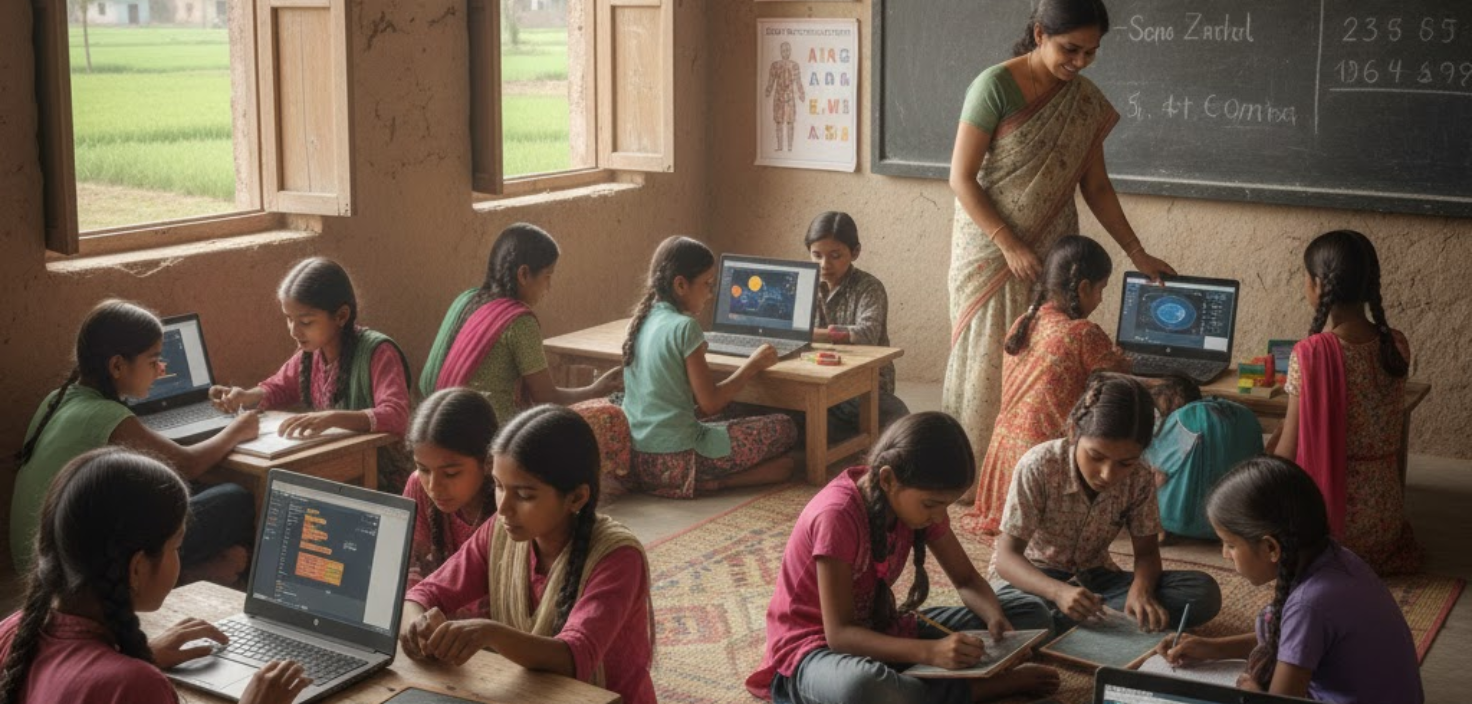
In Karnataka villages where CherYsh works, the school day doesn’t end when the bell rings. Children make their way to familiar community spaces which are warm, safe, and full of possibility. These are CherYsh After-School Learning Centers, where education is the doorway to confidence and a life of greater opportunity. Inside every Shiksha is a trained village woman who understands the rhythms of her community and the dreams the children around her carry. Under her care, learning becomes lively, hands-on and real.
A child who once hesitated to speak now reads aloud in English. Another who had never held a tablet explores the digital world with curiosity and solves STEM puzzles with ease. These small moments add up to a quiet transformation.
More than 20,000 children across 100+ villages have experienced this shift, growing up with the skills the future demands.
We follow a simple arc – Educate. Equip. Empower. Children start in our learning centers. Women find skills, confidence and a livelihood. The village moves forward.
Transforming Rural Education
CherYsh has spent over a decade bringing English to rural Karnataka, taught by local women who are part of the very villages they serve. That foundation is now expanding.
The program now covers English, Science and Mathematics for Grades 1–10, alongside AI Programming Labs and STEM Labs that bring digital and scientific discovery to villages where these things were once entirely out of reach. To make this possible, CherYsh has also expanded its empowerment program, by training rural women as Learning Facilitators, Lab Instructors and Lab Technicians.
“Our mission is to ensure that a student’s geography does not determine their potential. By bringing AI Programming and STEM to rural doorsteps, we are preparing students not just for exams, but for a digital future.”

AI & STEM LABS
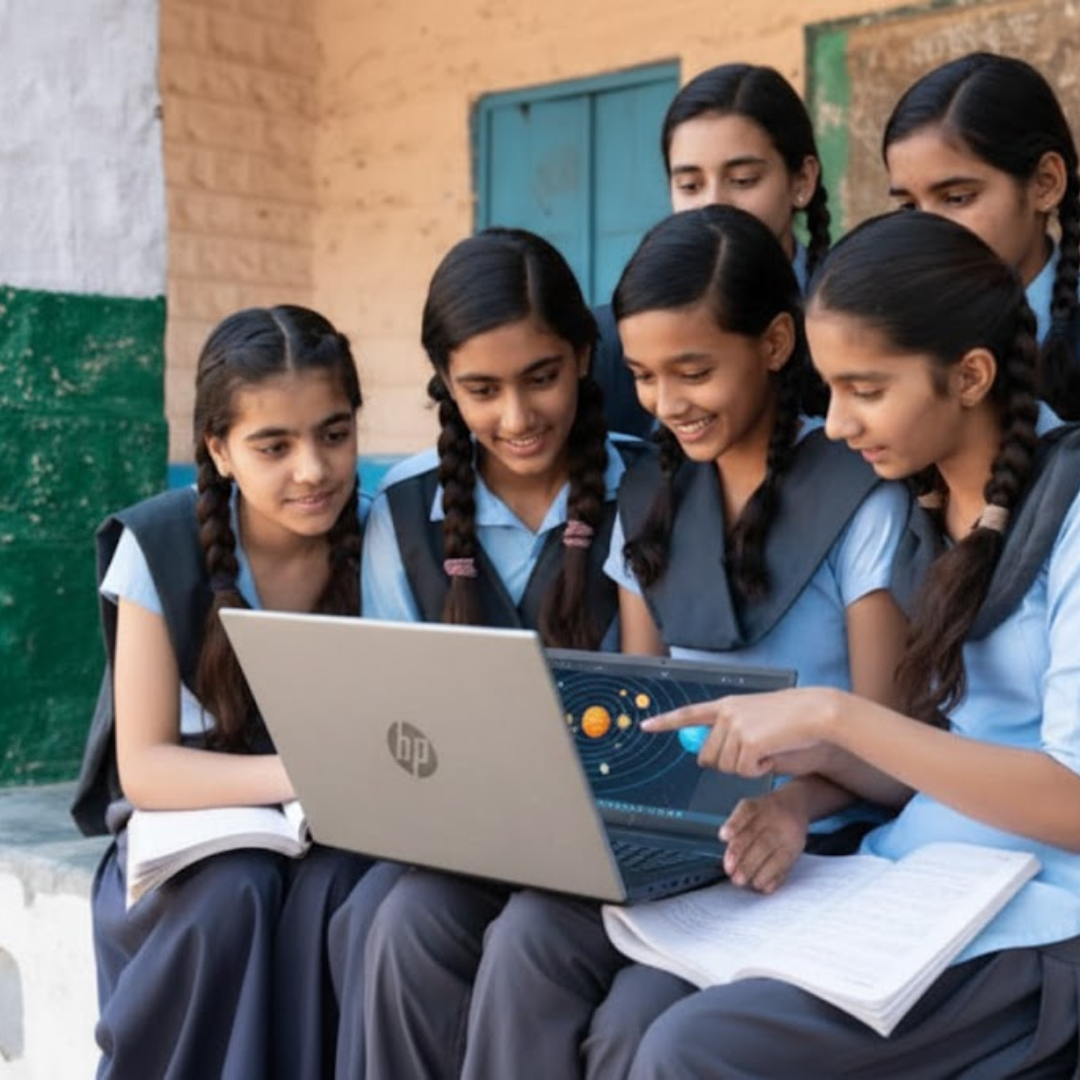
Through Cherish Educate, we focus on strengthening foundational and future-ready learning for rural children. With the growing emphasis on technology-driven education in Karnataka, where Artificial Intelligence (AI) and digital literacy are increasingly becoming part of the educational ecosystem, our goal is to ensure that rural students are not left behind in this transformation. We are establishing AI and STEM Labs in underserved schools to introduce students to Science, Technology, Engineering, and Mathematics (STEM) through hands-on, experiential learning.By integrating AI-based learning modules with the existing curriculum for Grades 6–10, we aim to make advanced concepts accessible, engaging, and relevant for students from marginalized and rural communities.
To strengthen the quality of learning and mentorship, we are collaborating with institutions such as KLE. Through these partnerships, corporate and academic volunteers support our initiative by mentoring students, conducting workshops, and assisting in the delivery of AI and STEM learning modules. Their involvement helps bring industry exposure, technical expertise, and innovative teaching approaches to rural classrooms.
Our Three-Pillar Approach
Three programs. One shared belief – Curiosity and capability belong in every classroom, in every village.
1. ESM Shiksha - English, Science and Mathematics
This is CherYsh’s academic program for rural Karnataka. Every child in every village deserves a quality education. Not a watered-down version of it. ESM Shiksha partners with schools to make sure that happens — bringing structured, high-quality learning directly to the children who need it most.
A Gap That Grows in Silence
In many rural classrooms, students are expected to keep pace with grade-level work before they have truly grasped the foundations. The gap is quiet. It doesn’t always show up immediately. But over time it shapes what a child believes they are capable of.
ESM Shiksha closes that gap early, while there is still time to change the story.
How We Teach
The program works on two levels at once , rebuilding the core concepts students may have missed, while keeping them moving forward with their grade-level curriculum. Students tackle projects rooted in the world they know (water conservation, smart agriculture, renewable energy). Learning that connects to village life makes the concepts stick.
- English — From phonics through to fluent communication
- Mathematics — Concept-driven, not rote
- Science — Activity-based and built around curiosity
- Technology — Digital tools, smart lesson plans and real-time progress tracking that flags where a child needs more support before the gap widens
What Changes
Within nine months, the difference is visible:
- Stronger reading fluency
- Sharper mathematical reasoning
- Deeper scientific understanding
- Children who raise their hands instead of looking away
The goal is not just better grades. It is students who are genuinely ready for what comes next.
2. AI Shiksha - In Collaboration with KLE University
Somewhere in a village in Karnataka, a child who has never touched a laptop is about to write their first line of code.
Building Future-Ready Digital Skills in Rural Classrooms
Developed in collaboration with KLE University, AI Shiksha brings coding, computational thinking and artificial intelligence into rural classrooms. The same skills that urban children are building today are now available in the villages where CherYsh works and in the hands of children who have never had access to them before.
Launched with support from individual donor families, AI Programming Labs are now running in several rural locations across Karnataka. They are designed for offline and low-bandwidth environments, so that a lack of stable internet never stops a child from learning to code.
How We Teach
The curriculum grows with the student:
- Grade 6 – Introduction to Scratch, a visual block-based coding environment that teaches logic through play and creativity
- Grades 7 & 8 – Foundations of Python, writing real code and building projects that solve real problems
Every step is learning by doing:
- Hands-on coding exercises
- Computational thinking – logic, patterns and algorithmic reasoning
- Visual simulations of Science and Math’s concepts that are hard to grasp through chalk and talk alone
- Real life application scenarios
Teachers are equipped with lesson plans, easy to use frameworks and AI-assisted tools, and trained continuously so their confidence grows alongside their students. KLE University brings its academic experience and curriculum expertise to this collaboration by opening doors to higher education and technology careers that rural children may not have imagined were meant for them.
What Changes
- Understand core programming concepts
- Think logically and computationally – system design, debugging and problem definition
- Build simple applications and projects
- Use technology with confidence
- Be ready for advanced AI and STEM pathways
For a child from a village in rural Karnataka, that is not a small thing.
3. STEM Shiksha - Science, Technology, Engineering and Mathematics
In a CherYsh classroom, the question that matters most is a simple one: what happens if we try?
Igniting Innovation in Rural Classrooms
STEM Shiksha turns classrooms into spaces where that question is not just allowed, it is the whole point. Students don’t sit and receive. They experiment, build, break things apart and try again. With support from ANSR Foundation and BPL Group CSR, CherYsh has launched fully equipped STEM Labs in rural schools across Karnataka, an active workspaces where theory meets practice.
How We Teach
- Activity-based science experiments – learning through doing, not watching
- Engineering design challenges – problems with no single right answer
- Mathematics in real-life contexts – pulled from the world outside the classroom
- Technology integration – curriculum-aligned lab kits that mirror the state syllabus, so lab time directly supports classroom learning
Students tinker, explore and build models, designing prototypes and working through problems rooted in their own world (water conservation, smart agriculture, renewable energy). Teachers are trained not to deliver answers but to guide the process, to ask the right questions and let curiosity lead the way. Each year, students present their innovations at community STEM Showcases, proving to their families and villages what rural children are capable of.
What Changes
- Strong conceptual clarity across subjects
- Practical problem-solving instincts
- Confidence to take on challenges they have never seen before
- A genuine interest in STEM careers
Future innovators, engineers and thinkers emerge from rural classrooms.
What This Looks Like in Practice
Students will… | Teachers will… |
Engage in real-world, hands-on STEM projects | Receive training in modern STEM teaching methods |
Develop critical problem-solving and collaboration skills | Learn to use AI tools and integrate lab sessions into daily teaching |
Strengthen scientific reasoning and conceptual clarity | Access mentoring and peer-learning support |
Gain early exposure to AI logic and digital tools | Build the capacity to sustain the program long after launch |
The Difference One Program Makes
Every child who walks into a CherYsh Shiksha center walks out a little different. A little more curious. A little more confident. A little more certain that the future has a place for them in it.
What People Say
Our Partners In Transformation
We don’t work alone. Every partnership is a collaboration between belief and action.









 LinkedIn
