
CherYsh Educator Program

Women empowerment is one of the cornerstone principles at CherYsh. Another pivotal program under this principle is the “CherYsh Educator Program.” This program aims to empower local women as teachers, helping to meet the educational needs for the young children of their communities. English, science and maths teachers, often referred to locally as “Learning Facilitators” undergo over 50 hours of in-person sessions and supplementary online training that focuses on pedagogy, technology, and subject coaching. Modules incorporate interactive activities, songs, and play to create an engaging learning experience. This approach has transformed over 200 women into confident educators and master trainers with stable incomes. Their societal dignity contributes to improved learning outcomes for the rural children they teach. Key Partnerships Supporting the Program CherYsh has developed one of the most widely recognized Learning Facilitator Training Programs in rural India. Collaborating with esteemed institutions such as the Council for Technical Education (CFTE), Pi Jam, Raspberry Pi, KLE Technological University, Intel Corporation, and Deshpande Private Industrial Training Institute (DIPTI). As a result, this program underscores excellence in education, technology, and subject matter expertise. Strategic Partners and Focus Areas CFTE E-classroom modules for STEM education. Pi Jam Coding education and master trainer programs. Raspberry Pi Hardware provision and user training KLE Tech University Coaching in English, Math, and Computer Science Intel Corporation Technology infrastructure support. DIPTI Training in multimedia tools. Thoughtworks Software training Program Overview CherYsh identifies and trains young, qualified women from Haliyal’s rural communities to become educators and master trainers in technology for the various CherYsh Shiksha Centers. The 12-month learning facilitator program comprises weekly sessions covering pedagogy, technology integration, and subject-specific coaching (English, Mathematics, and Computing). Each educator is provided with a digital tablet, preloaded with curated content from CherYsh’s strategic partners. Our Differentiation Our Impact Graduates of the program emerge as competent educators with stable incomes, contributing to rural development and enhanced learning outcomes for students. Through education and skill development, CherYsh empowers women, transforming communities and fostering sustainable socio-economic progress.
CherYsh Junior Shiksha Program

Education of girls in rural India is one of the cornerstone principles at CherYsh. In fact, this is one of the main reasons why CherYsh was founded. Another pivotal program under this principle is the “CherYsh Junior Shiksha Program.” CherYsh Junior Shiksha empowers rural communities by nurturing young minds, fostering creative and emotional growth, and engaging parents in their children’s educational journeys. Together, these efforts are transforming the lives of rural children and shaping a brighter future for women as well. CherYsh Junior Shiksha provides holistic development opportunities for rural children in India through After-School Learning Centers. These centers are in the government schools located in over 30 villages at any time and offer a supportive neighbourhood learning environment led by trained young women as Learning Facilitators and Master Trainers. Program Highlights:1. Active Rural Curriculum: Engaging methodologies such as music, art, puppetry, and games help teach English and Mathematics through phonics-based learning modules.2. Digital Integration: Tools and e-learning modules enhance education, incorporating the Meghshala digital platform.3. Creativity and Physical Well-being: Weekly sports activities and hands-on workshops, including clay modelling, paper crafts, creative writing, plays, songs, and dance, nurture physical and creative growth. Since 2015, CherYsh has impacted over 10,000 children, fostering academic success and personal growth in rural communities. Strategic Partnerships CherYsh collaborates with CFTE and Ontum Education Pvt. Ltd. to deliver innovative digital education. CFTE STEAM (STEM + Art) modules align with CherYsh’s goals, offering e lessons enriched with images, videos, and strategies. The content is accessible offline via tablets used by our Learning Facilitators, thereby ensuring learning continuity even in areas with limited internet access. Program Goals and Objectives To provide foundational learning with a focus on holistic language and numeracy development for rural children, especially girls, empowering them for lifelong success. The key objectives were as follows: 1. Enhance Foundational LearningImprove literacy and numeracy proficiency by 20% in the first year.Implement age-appropriate curriculum tailored to student needs.2. Foster Holistic Language DevelopmentEnhance listening, speaking, reading, and writing skills, improving language proficiency by 15% in two years.Use interactive storytelling, language games, and group discussions.3. Promote Socio-Emotional GrowthBuild emotional intelligence and social skills through confidence-building exercises, teamwork, and mindfulness techniques.4. Increase Parental EngagementBoost parental participation in workshops and meetings by 25% over three years, fostering a supportive home learning environment. Key Activities 1. Foundational LearningConduct pre-assessments to address learning gaps.Deliver interactive sessions on basic literacy and numeracy.Regularly evaluate and refine teaching methods.2. Language DevelopmentIntegrate storytelling, language games, and group activities.Provide structured writing exercises to enhance expression.3. Socio-Emotional DevelopmentEncourage role-playing, teamwork, and mindfulness.Foster a safe environment for emotional expression.4. Parental EngagementHost parent-teacher meetings and workshops.Organize “Show and Tell” events to strengthen community involvement. What People Say “As a CherYsh™ Junior Shiksha program student, I can confidently say it transformed my life. Before joining, I struggled with English and Math, making it hard to keep up with classmates. But now, I have quality learning support right in my neighbourhood.” Ashwini, Student, Yedoga Village “Beyond academics, the CherYsh™ Junior Shiksha program fosters students’ growth in sports, art, and creativity. Witnessing their blossoming creativity fills me with gratitude. It has also boosted my teaching confidence, making me a respected village member. I hope more villages in the region can benefit from this program.” Ms. Savitri Channappa Ugnikeri, Learning Facilitator, Kavalwad Village
CherYsh Gram Labs (formerly eShiksha) Program

Education of girls in rural India is one of the cornerstone principles at CherYsh. In fact, this is one of the main reasons why CherYsh was founded. Another pivotal program under this principle is the “CherYsh Gram Labs (formerly eShiksha) Program.” The Gram Labs (formerly eShiksha) program bridges the digital divide by offering quality technology education to rural students. By empowering Learning Facilitators and Technology educators and equipping e Shiksha Centers with cost-effective digital tools, the program fosters holistic digital learning and problem-solving skills through coding, digital making, and computational thinking. Primary Objectives of Gram Labs (formerly eShiksha)1. Digital Literacy for AllTraining students in programming, logical reasoning, and physical computing through hands-on coding in Scratch, Python, and HTML.Encouraging project-based learning, with students creating competition-worthy projects annually.2. Community-Centric DesignRevamping existing community spaces to establish fully equipped computer labs accessible to students from Grades 5 to 9.Engaging local women as trained Learning Facilitators to build sustainable computing education ecosystems.3. Integrated CurriculumA 50-hour, grade-specific computing curriculum that blends academic subjects (Math, Science, and English) with practical coding applications.Physical computing, problem-solving, and design-thinking modules emphasize real-world relevance.4. Empowering EducatorsOngoing training for Learning Facilitators to master digital tools, deliver interactive lessons, and integrate computational skills into teaching. Program ImpactOperating in Haliyal Taluk, Karnataka, for over three years, e Shiksha has:Reached over 100 students per center across multiple rural villages, benefiting learners aged 10 to 16.Created a recurring 12-month intervention cycle to provide continuous support for students and facilitators. A Flagship Partnership: Technology, Learning, and Livelihood InfrastructureCherYsh launched its flagship partnership with KLE Technological University in 2012, which has grown into a groundbreaking joint venture in 2024 with the establishment of the KLE-CherYsh Center of Excellence for rural STEM education. Recognizing that modern learning and livelihood programs depend on technology, electric power, computers, and Wi-Fi, CherYsh developed strategic partnerships with KLE Technological University, Intel, Selco and Mphasis to overcome these challenges. The KLE-CherYsh Partnership focuses on sustainable digital solutions for rural villages, that includes stable electric and communications solutions. Since 2012, KLE’s Rural Innovation Through Education (RITE) volunteer program has empowered university students to mentor rural children in technology and mothers in entrepreneurship, enabling knowledge-sharing and skill-building in underserved areas. Over 100 STEM college students have participated in the RITE program, contributing to rural development. To further support CherYsh and other partners step in by providing training in software, communications, and digital hardware for both students and Learning Facilitators (LFs). These partnerships have been instrumental in scaling CherYsh’s modern learning and livelihood programs across rural communities. CherYsh collaborates with leading organizations to enhance the Gram Labs (formerly eShiksha) initiative:1. PiJam Foundation: Supplies content, hardware, and training for digital literacy programs.2. Raspberry Pi Foundation: Provides affordable hardware (Raspberry Pi processors) and baseline assessments.3. ThoughtWorks: Delivers communications platforms and technological infrastructure. STEM Integration in Gram Labs (formerly eShiksha) To deepen the impact of e Shiksha, the program integrates STEM (Science, Technology, Engineering, Mathematics) education:Curriculum Design: Practical modules in robotics, circuitry, and engineering challenges.STEM Kits: Tools and resources for interactive experiments, emphasizing applied learning.Educator Support: Training Learning Facilitators in STEM education methodologies. Program Objectives 1. Develop Digital Proficiency: Enhance programming, logical reasoning, and physical computing skills among rural students.2. Foster Creativity: Encourage students to create projects for coding competitions, promoting innovation and critical thinking.3. Empower Learning Facilitators: Train young women as Master Trainers to sustain and scale the program.4. Promote Inclusivity: Increase access to quality technology education for rural girls, creating a gender-equitable learning environment.5. Integrate STEM Skills: Equip students with practical knowledge that bridges academics and real-world applications. Outcomes and Vision Establish a pipeline for technical education, higher studies, and tech careers in rural areas.Empower a network of women Master Trainers who can teach tech in regional languages.Close the digital divide, providing students with tools to compete with their urban counterparts. Participate in this century’s digital economySpark local innovation by creating platforms for tech expression and entrepreneurial exploration. With support from the Ministry of Education and continued collaborations, CherYsh aims to transform rural STEM education and livelihoods, ensuring every child has the tools to thrive in a technology-driven world. What People Say “I started as a junior Shiksha facilitator at CherYsh™ Trust and later became a computer facilitator. Despite initial challenges, training equipped me to teach computers to students, many from tribal communities. Teaching them requires patience. I’m grateful to CherYsh™ for bringing the program to this remote village. The villagers have embraced it, providing all the necessary support.” Ms. Kanchana Kammar Learning Facilitator, CherYsh eShiksha Program, Tattigera village “As a proud eShiksha program parent, I’m thrilled to see my daughter, Soumya’s, incredible progress. Before joining, she had no computer or technology experience. Now, she’s confident and skilled. Watching her work and enhance her tech abilities daily is wonderful. I’m fortunate Soumya had CherYsh™’s eShiksha program.” Neelavva Soumya, Mother, CherYsh eShiksha Program, Arlwad village “In a small classroom, the eShiksha program began. Initially unfamiliar with computers, the children learned basics in a fun way. They used mice and explored Raspberry Pi tools for educational software. As weeks passed, they mastered tasks like typing, creating digital art, and coding simple programs. Their excitement grew as they discovered technology’s endless possibilities. CherYsh, a life-changing force in our villages, made this possible.” Mr. M Danagge, Headmaster, Janaga Village “Initially unaware of computers, I assumed learning MS Word and Excel would suffice. However, CherYsh™ offered more than that. I discovered coding and computing, which ignited my passion. Seeing the LED light up after successfully coding filled me with pride and joy. I’m grateful for this chance to learn and grow.” Aaditya Bhatkhande, Student, Standard 6, Government Higher Primary School, Alur
Case Study: Demakka’s Roti Revolution!

A homemaker with a passion for baking and sharing rotis embarked on an inspiring journey with CherYsh, which transformed her life and her kitchen. Let us delve into her remarkable story. Demakka, a devoted homemaker and mother of three, changed her life through entrepreneurship with the support of CherYsh and Roviralta, an organization dedicated to uplifting people’s lives. This case study showcases Demakka’s journey from a small-scale roti seller to a thriving businesswoman, with CherYsh, the Selco Foundation, and the Roviralta Foundation playing a crucial role in her success. Before starting her entrepreneurial venture, Demakka sold rotis to her neighbours to help support her family. A few years ago, CherYsh, in partnership with the Roviralta Foundation, built Community Kitchens in Haliyal. The goal was to teach village women about food hygiene, reduce the use of wood and coal for cooking, and help them develop skills in commercial food production. Partners like Taj Gateway and Akshaya Patra provided training in Hubli, and these kitchens became the foundation for entrepreneurial food product ideas. CherYsh recognized Demakka’s potential and, in collaboration with the Selco Foundation, provided her with a solar-powered roti-making machine and essential training. Eager to build her own business, Demakka seized the opportunity. With CherYsh’s guidance, she learned how to efficiently operate the solar-powered machine. This not only boosted her production but also reduced her reliance on conventional energy sources something that Cherysh and Roviralta aimed for since 2013. When the challenges of COVID-19 arose, Demakka didn’t give up. Instead, she and her family used this adversity as an opportunity for growth. Today, she is producing rotis not only for her neighbourhood but also for nearby towns and villages. Despite the challenges of the pandemic, Demakka’s resilience, along with the sustainability of her business model, helped her overcome obstacles. Her family joined her in the venture, contributing to its growth. A standout feature of Demakka’s success story is the solar-powered roti-making machine. This reflects both environmental consciousness and innovative solutions from CherYsh that empower individuals through livelihood programs. Demakka’s approach is also noteworthy; she never turns away a customer, even if they only need a few rotis. For her, it’s not just about making money, but about feeding people. Her commitment to providing food, no matter the order size, underscores the ethical foundation of her business. She values customer well-being over profit, highlighting the importance of ethics in entrepreneurship. But Demakka’s ambitions don’t stop here. She dreams of expanding her business even further, hoping to acquire flour mill equipment; not just for her family, but to benefit her entire community. With some training and a great deal of enthusiasm, Demakka transitioned from a home cook to a roti-making star. Her journey from homemaker to successful entrepreneur is a powerful testament to the transformative impact of livelihood programs. Demakka’s story is not just about rotis; it’s about turning everyday things into something extraordinary. Thanks to CherYsh and a solar-powered machine, her kitchen became a business hub, and Demakka proves that with the right support, anyone can make a big difference. CherYsh’s strategic collaboration with Roviralta, the Selco Foundation and emphasis on sustainable business practices have not only empowered Demakka but have also set an inspiring example for women entrepreneurs. Demakka’s story serves as a beacon of hope, illustrating the potential within every individual when given the right opportunities and support. Let’s celebrate Demakka’s Roti Revolution and the incredible possibilities that emerge when we work together to make a difference!
Case Study: Savitri’s Sugarcane Nursery in Mundwad

Savitri, from Mundwad, has cultivated more than just a nursery in her village – she has nurtured resilience and success. Her journey from starting a sugarcane bud nursery to thriving in a male-dominated industry is a testament to her determination and the support she received. Savitri’s venture began with training at the Murugappa Group in Chennai, supported by CherYsh, where she learned the ropes of establishing a sugarcane bud nursery. She excitedly walked us through the entire process – from cutting sugarcane buds using a machine to utilizing cocopeat for germination and packing the seedlings. A remarkable detail is how she cleverly returns any waste from the cutting process to the sugarcane factory, ensuring minimal waste. Savitri proudly shared that she sold approximately 8 lakh seeds last year – a truly impressive accomplishment. However, her journey has not been without hurdles. Initially, CherYsh trained three women from her village to help start the nursery. Unfortunately, they faced challenges with germination, and her partners eventually decided to abandon the project. Undeterred, Savitri pressed on, and her unwavering determination eventually paid off. Today, she not only turns a profit but also provides seasonal employment for around 10 people in her nursery. Savitri recalled the scepticism and mockery she faced from others who doubted that women could succeed in such an industry. Her response was simple yet powerful: “People were making fun of us saying women cannot succeed in these kinds of things, which made me want to prove them wrong.” Over the course of six years, Savitri has built a thriving nursery and developed strong relationships with farmers, creating a loyal customer base. Early on, she faced financial challenges, particularly in sourcing water for her operations. But her perseverance led her to own a borewell, solving the water issue and allowing her business to flourish. Innovations for Sustainability: Savitri’s commitment to sustainability shines through in her initiatives. She created a vermicompost space to efficiently use waste cocopeat and seed wastage, demonstrating her dedication to minimizing her environmental impact. Life Lessons and Support: Savitri shared her life philosophy, emphasizing the importance of navigating both sadness and happiness with grace. She spoke about facing challenges head-on and forging one’s own path. Savitri also highlighted the invaluable support from her husband, recognizing how essential a strong support system is in overcoming obstacles. Savitri’s story is a powerful example of resilience and determination. Her journey shows how community support and perseverance can turn challenges into triumphs. Her sugarcane bud nursery not only contributes to the local economy but also stands as a symbol of empowerment, breaking gender stereotypes in the agricultural landscape.
Case Study: Shehnaz’s Knitting Revolution in Mundwad

Meet Shehnaz, the driving force behind a knitting revolution in Mundwad. What began as a personal hobby has blossomed into a community empowerment initiative, transforming the lives of women in her village through skill, determination, and shared success. Shehnaz, originally from Agra Cantt, lived with her ex-army husband during his service, where she developed her skills in nail knitting. When her husband retired and they returned to Mundwad, what started as a domestic activity soon became something much bigger. Recognizing Shehnaz’s talent, CherYsh saw an opportunity to turn her knitting passion into a thriving business. With CherYsh’s support, Shehnaz began sharing her craft with around 50+ women in the village. This initiative gave each participant artisan cards, which not only identified them as artisans but also enabled them to participate in exhibitions across cities like Kolkata, Bangalore, Nagpur, and Pune. The exposure helped the women broaden their horizons and gain recognition for their work. Shehnaz highlights the economic impact this initiative has had on the women in her community. By earning additional income from their knitting, these women have gained financial independence, all while balancing their regular activities. Their travels to various cities exposed them to new experiences, from visiting beaches to navigating sleeper buses and trains—experiences that have taken them far beyond their previous village life. Driven by a desire to uplift other women in her village, Shehnaz finds joy in seeing them become financially independent and empowered. For her, this work is not just about knitting—it’s about transforming lives and creating opportunities for others. CherYsh’s collaboration with V-Act NGO expanded market linkages for Shehnaz and her team, bringing more opportunities their way. Additionally, Shehnaz received advanced training from NIFT Bangalore, and in turn, she trained around 70 NIFT students in nail knitting, enhancing both her expertise and that of others. Shehnaz recognizes the challenge of convincing women to step out of their comfort zones and turn their skills into profitable ventures. She firmly believes that government jobs alone cannot provide for everyone and encourages others to seize opportunities, such as the Artisan cards, to create sustainable livelihoods. Now, Shehnaz has her sights set on an exhibition in Delhi, eager to explore new designs in nail knitting and further expand her business. Her story is a powerful testament to the transformative potential of skills, community collaboration, and the ripple effect of empowerment. From Agra Cantt to Mundwad, Shehnaz’s journey is a shining example of how CherYsh’s creating opportunities and fostering creativity can shape a brighter future for women in the community.
Case Study: Cultivating Sustainability: Fakkirappa Vermicompost Story
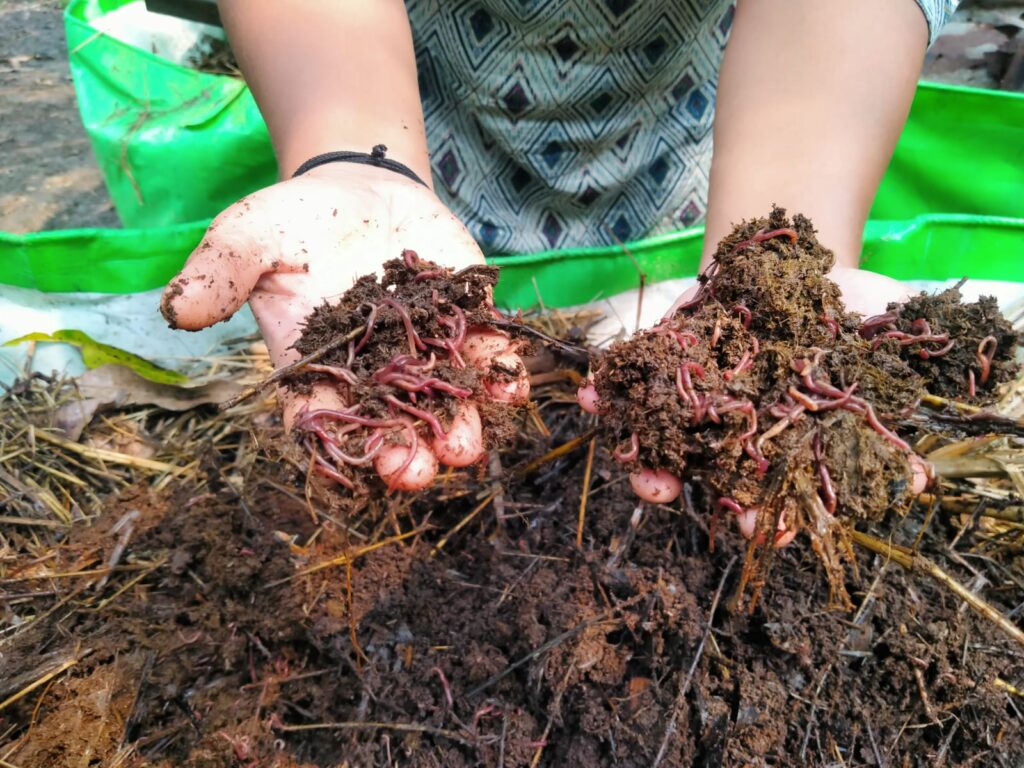
Fakkirappa, a dedicated farmer with a passion for innovation, began his vermicomposting journey eight years ago. Unfortunately, his initial attempt faltered due to a lack of proper guidance and water resources, leaving him with unsatisfactory results. However, his fortunes changed when CherYsh, recognizing his proactive attitude, reached out and introduced the idea of revitalizing his vermicomposting efforts. This partnership not only transformed Fakkirappa’s approach to farming but also became a shining example of sustainable agricultural practices in his community. CherYsh, committed to sustainable development, extended its support to Fakkirappa and five other like-minded farmers. We provided comprehensive training sessions in the Karwar region, equipping them with the knowledge and skills needed to succeed in vermicomposting. Furthermore, CherYsh supplied essential materials such as composting bags and worms—key elements for creating a thriving vermicomposting system. Just three months into the project, Fakkirappa and his fellow farmers made impressive progress. The compost was ready, marking a significant milestone in their journey toward sustainable farming. CherYsh has been instrumental in ensuring the quality of the compost, even conducting tests to verify its effectiveness. Fakkirappa’s dedication to sustainable farming extends beyond composting. With CherYsh’s support, he is constructing a permanent shed specifically for vermicomposting. This infrastructure will not only ensure a reliable and consistent supply of compost but also reflects Fakkirappa’s long-term vision for sustainable agriculture. The Importance of VermicompostVermicompost plays a vital role in sustainable farming. Enriched with nutrients from earthworms, it acts as a potent organic fertilizer, enhancing soil fertility without the harmful effects of chemical fertilizers. It boosts microbial activity in the soil, improving structure, water retention, and nutrient absorption by plants, leading to healthier crops and a more sustainable farming model. Sustainable Measures and Economic ImpactFakkirappa’s embrace of sustainable farming practices, particularly vermicomposting, is not only contributing to environmental preservation but also improving his financial well-being. By reducing reliance on chemical fertilizers, he lowers input costs, making farming more economically viable. Furthermore, by selling surplus compost to local farmers, he generates additional income, highlighting the dual benefits of sustainability and financial stability. Fakkirappa’s ImpactFakkirappa’s transformation from a failed vermicomposting attempt to a thriving example of sustainable farming is a powerful testament to the impact of guidance and collaboration. With CherYsh’s support, coupled with Fakkirappa’s determination, his efforts have revitalized vermicomposting and become a catalyst for sustainable agriculture in his community. As he continues to build his vermicomposting infrastructure, Fakkirappa’s story stands as an inspiring example of how one farmer’s commitment to sustainable practices can positively influence the environment, community, and his own livelihood.
Case Study : Empowering Threads: Tattigere Quilting Collective

In the charming village of Tattigere, a group of women has transformed the traditional craft of quilting into a thriving business. Led by Ashabi and supported by the CherYsh organization, these women have not only created beautiful handwoven quilts but have woven a powerful story of empowerment, collaboration, and community transformation. Ashabi, a talented quilter, inherited her skills from her mother and grandmother, preserving the rich quilting tradition that has been passed down through generations in Tattigere. Building on this heritage, Ashabi and other women in the village, all skilled in the craft, came together to turn their shared passion into a sustainable business venture. CherYsh has been a key ally in the success of the Tattigere Quilting Collective. Recognizing the potential of the women’s craftsmanship, CherYsh has provided valuable resources, training, and a platform to help these women take their quilts to a larger market. This support has not only boosted the community’s economy but also empowered the women to use their skills to achieve financial independence and contribute to the broader community. The quilts produced by the Tattigere collective are more than just functional items; they are pieces of art. Each handwoven quilt adds a burst of color and warmth to a home, carrying with it the story of tradition, skill, and the collaborative spirit of the women who created it. These quilts bring beauty and meaning into living spaces, making them cherished possessions. Within the collective, the women have embraced their unique strengths. Ashabi notes that some members are excellent communicators, and these women are tasked with representing the group at exhibitions and markets. This strategic division of labour allows the creative artisans to focus on their craft, while others handle the business side of the venture, helping the collective reach a broader audience. When asked about the future of their quilting business, Ashabi expresses a desire for their work to be recognized beyond Karnataka. Her dream is for Tattigere quilts to become a celebrated art form across India, showcasing the talent and dedication of the women in her village. Quilting Impact The Tattigere Quilting Collective stands as a shining example of how community collaboration and entrepreneurship can transform lives. With the support of CherYsh, these women have not only revitalized a traditional craft but have also created a business that brings economic empowerment to their village and allows for children to remain in school. Each quilt is a testament to their resilience, creativity, and the enduring spirit of women working together to build a brighter, more colourful future. As Ashabi and her fellow artisans aim to take their quilts to every corner of the country, the Tattigere Quilting Collective represents a powerful story of empowerment, heritage preservation, and dreams that know no bounds.
CherYsh English Shiksha Program

Education of girls in rural India is one of the cornerstone principles at CherYsh. In fact, this is one of the main reasons why CherYsh was founded. Another pivotal program under this principle is the “CherYsh English Shiksha Program.” The CherYsh English, Science and Maths (ESM) Shiksha Program, in partnership with the Deshpande Foundation and supported by Tata Elxsi’s CSR initiative, empowers rural students aged 10 to 14 in Haliyal Taluk, Karnataka. Over three years, this initiative has enhanced English proficiency, self-confidence, and essential communication skills among students, enabling them to understand computing technologies, pursue higher education and better opportunities. Partnering with Deshpande Foundation, Hubli (https://detedu.org/skill-in-village/), the SiV is an after-school program for students in primary and upper primary classes (Grade 5-8) of government schools in rural areas to equip them with life skills and English communication skills. Our program model gets embedded in the communities, steadily knitting itself with the various stakeholders—students, parents, School Development and Monitoring Committee (SDMC) members, and village Panchayats. Overview and ImpactThe program targets 30 to 35 students per Shiksha Center, benefiting over 1,000 students annually across 30+ villages and over 20 government schools. In addition to improving language skills, it fosters critical life skills such as leadership, problem-solving, and interpersonal communication. Young women from local communities are selected and trained as Learning Facilitators, providing them with respectable, prestigious and sustainable livelihoods. Major Outcomes– Improved spoken and written English skills.– Boosted student confidence and vocabulary.– Enhanced communication and life skills through interactive activities and workshops. Program Goals and ObjectivesTo educate rural students with proficient English language skills, foster confidence, and develop essential life skills, enabling holistic growth and better opportunities. The primary objectives were as follows: – Enhance Language Proficiency– Develop reading, listening, and speaking skills.– Deliver curated language lessons using interactive methods.– Provide resources like workbooks and audio materials for extended learning.– Boost Self-Confidence– Conduct activities that encourage self-expression in English.– Facilitate group discussions and celebrate student achievements.– Track confidence improvements through pre-and post-assessments.– Foster Effective Communication– Engage students in role-plays, presentations, and peer-interaction activities.– Provide constructive feedback on communication style and clarity.– Instil Life Skills– Organize workshops on critical thinking, problem-solving, and leadership.– Promote teamwork through collaborative projects.– Enable real-life applications of life skills and monitor progress. Key Activities– Language Proficiency– Conduct baseline assessments and create tailored learning plans.– Deliver lessons focused on key language components—reading, writing, listening, and speaking.– Self-Confidence Building– Facilitate judgment-free group discussions and role-plays.– Recognize progress to boost students’ morale.– Effective Communication– Promote oral communication through interactive exercises.– Encourage peer collaboration and feedback for improvement.– Life Skills Development– Host workshops and collaborative activities to teach critical skills.– Provide opportunities for practical application and track development over time. Learning Facilitator DevelopmentThe program emphasizes the training of Learning Facilitators, with a robust 50+ session calendar supplemented by online modules. Women from local communities are equipped with pedagogy, technology, and subject coaching, transforming them into confident educators while improving learning outcomes for students. The CherYsh English Shiksha Program is a transformative initiative that bridges educational gaps, empowers students, and uplifts communities. By fostering confidence, communication, and life skills, the program ensures lasting impact for rural children and young women. What People Say “I’m Ravi Mantur, a Teregaon student. I thank CherYsh for their English Shiksha program. Before joining, English was challenging, but my skills improved significantly. I now speak English confidently. My parents are thrilled. Thanks to CherYsh excellent teaching methods, I can communicate confidently in English.” Ravi Mantur, Student, Belwatagi Village “I’m Jaishri, a CherYsh™ English Shiksha program facilitator. Before joining, my English was limited, but the program improved my communication and critical thinking skills. Activity-based learning and well-designed workbooks helped students retain what they learned. The program also emphasizes personality development, crucial for students’ overall growth. Today, I’m confident teaching English, and I owe it all to CherYsh™ and their excellent teaching methods.” Jaishri, English Shiksha, Learning Facilitator, Mundwad Village “As head of the Deshpande Foundation’s Skill in Village Program, I’m proud to partner with CherYsh™ to bring quality education to government schools in Haliyal district. CherYsh™’s strong network and local connections have been key to the program’s success. Ms. Kaveri, a cluster head and trainer, delivers well-prepared content and modules. Combined with Deshpande Foundation’s training and assessment tools, this partnership has positively transformed students’ lives. Classes 5 to 8 now receive quality education, boosting their confidence and motivation. This collaboration has also led to improved exam scores. We’d be delighted if CherYsh™ expanded its program beyond Haliyal district, impacting more communities and benefiting students across the region. Together, we can make a meaningful difference in rural students’ lives.” Harish, Deshpande Foundation, Skill-in-Village





 LinkedIn